Share


You didn’t make a single bad decision. You hired a strong team, controlled your costs, and balanced your books. Yet, when you reviewed your cash position at the end of the business year, its dollar value was significantly smaller. That's the result of unhedged currency exposure.
For instance, in March 2023, a business held ₦10 million in cash reserves. At the time, the official naira-dollar rate was about ₦462 per $1, making the reserves worth roughly $21,650.
By March 2026, the naira had depreciated to about ₦1,384 per $1. That same ₦10 million was now worth approximately $7,230, with a loss of 67% of its dollar value.
This effect becomes even more staggering at the scale where most mid-sized Nigerian businesses operate:
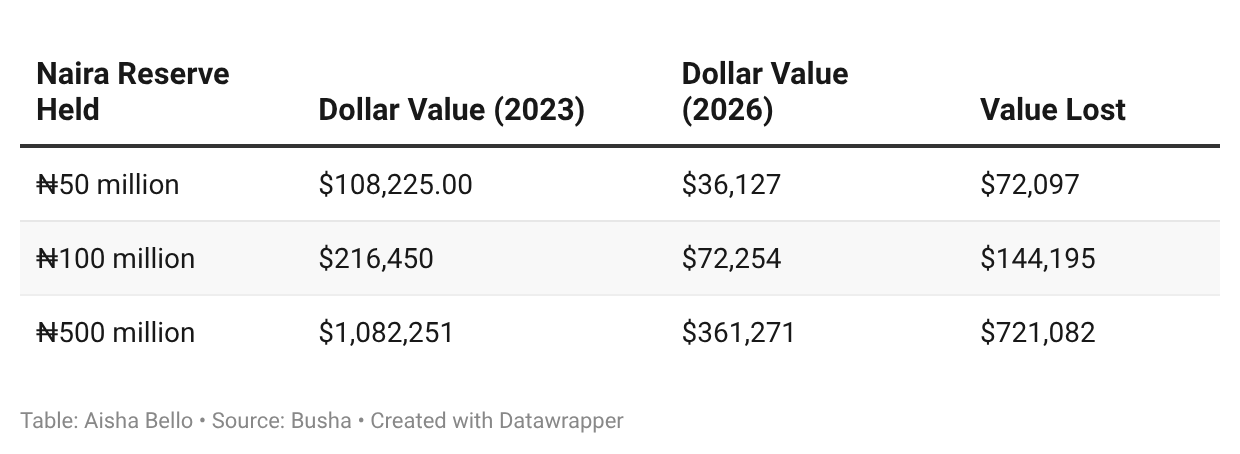
The ₦500M business reserve didn't lose more than $721,000 in value due to risky bets or poor management. The loss happened simply by holding naira. Every day the currency depreciated, the reserves lost value.
In 2026, leaving large naira balances idle is a costly decision, and at this scale, that cost is enormous.
The FX markup you're absorbing every month
Every time a Nigerian business makes an international payment — paying a supplier, settling a SaaS subscription, remitting a vendor invoice — a markup of between 3% and 5% is typically embedded in the rate. It doesn't appear as a line item. It sits quietly inside the exchange rate your bank or provider quotes you, and it compounds every single month.
At $100,000 per month in international payments, a 4% blended markup costs your business $48,000 a year.
A business processing $500,000 per month in international payments is effectively sending $240,000 to its FX provider every year, on top of its actual procurement costs. For most Nigerian businesses in manufacturing, tech, or logistics, this is one of the highest hidden costs on their P&L, and they've simply never accounted for it.
Note: the less transparent your FX channel is, the harder it is to see the true cost. Informal dollar markets, bank transfers, and many fintech corridors often build their margin into the exchange rate itself. The quoted rate looks like an exchange rate, but part of it is effectively a fee.
What idle naira actually costs
Most Nigerian business current accounts earn little to no interest. That's the standard.
For a long time, that was manageable because inflation, while high, was still within a range businesses could absorb. But that changed sharply in 2023, and the problem has not gone away.
₦50M sitting idle costs approximately ₦7.5M/year
At 15% inflation in 2026, uninvested naira loses 15% of its real value annually. On a ₦50M balance, that's ₦7.5M in purchasing power lost, while the current account balance stays the same.
Wages go up, input costs rise, and rent is renegotiated. Yet the cash on hand covers fewer and fewer operational costs.
All the hidden costs in one company
Consider a mid-sized importer operating in Lagos, with ₦200M in naira reserves, $150,000 per month in international supplier payments, and no yield-generating instruments on its idle cash.
Here’s what a 2023 high‑inflation, high‑depreciation environment would cost them in structural losses
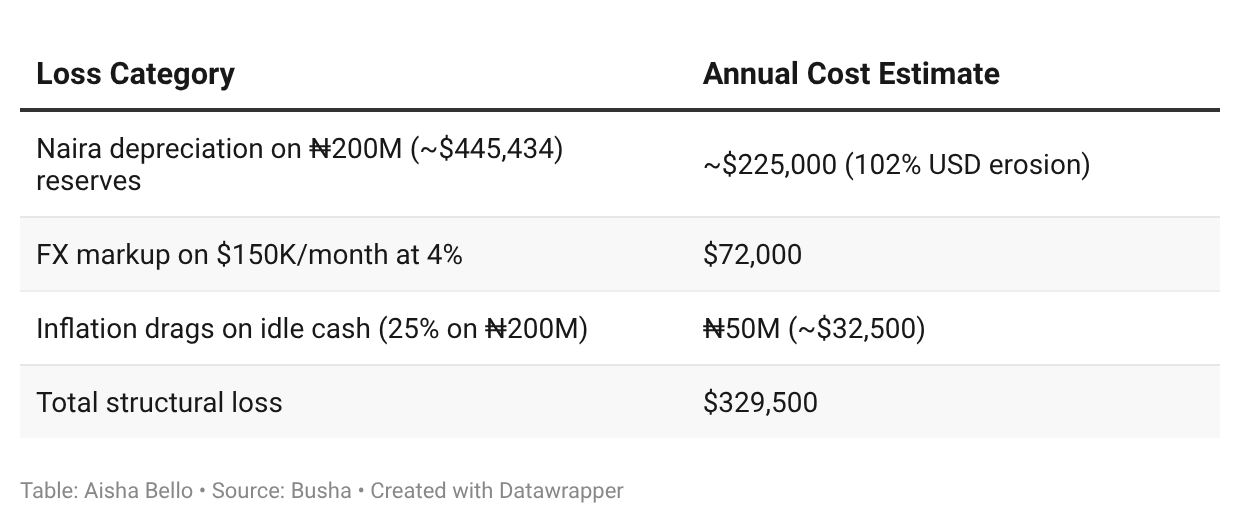
That’s a roughly 70% loss in dollar-equivalent value of that ₦200M reserve, all from currency exposure, transaction costs, and idle cash. These are the hidden costs of being passive with your business’s cash reserve in Nigeria’s macroeconomic environment. And most Nigerian businesses treat these as background noise rather than manageable risks.
Busha Business was built to close each of these gaps in a single platform. SEC-licensed and designed for Nigerian businesses serious about their treasury, we offer over-the-counter (OTC) dollar access at competitive rates, a Treasury product that puts idle naira to work, a Savings product for yield on dollar balances, and a full-featured API for businesses that want to embed FX and payments into their own systems. Know Your Business (KYB) takes 48 hours. The losses described in this piece don't have to be the cost of doing business in Nigeria. They just have to be effectively addressed. Get Started with Busha Business.