

Share


For a fintech with an established product, adding crypto payments can seem like a straightforward product expansion. In practice, it also means adding a new infrastructure layer and deciding what to build in-house and what to integrate.
A neobank adding stablecoin balances needs a new infrastructure layer. A payments company accepting stablecoins has to support a new payment flow. An exchange adding fiat on- and off-ramps has to build the systems that make those transactions possible.
Building that infrastructure in-house means taking responsibility for the technology, security, compliance, and operations required to run it, not just at launch, but over time.
So the real question is: which parts of your product are worth building in-house, and which are better integrated from an infrastructure provider?
Why Build Infrastructure That Already Exists?
Consider what happens when a customer makes a stablecoin payment.
The application needs to create or identify the appropriate payment destination, initiate the transaction, determine when payment has been received, update the customer's account, and reconcile the transaction. If the business also converts between fiat and crypto, it needs pricing and transfer mechanisms for those flows. If it is transacting on behalf of customers, onboarding and verification become part of the process.
The company is spending engineering resources recreating capabilities that already exist across the financial infrastructure market, while its actual competitive advantage may lie elsewhere: the customer experience, distribution, pricing, merchant network, or financial service it has built around those capabilities.
The infrastructure may be critical to delivering your product, but that does not make it your competitive advantage. Build what makes your product different. Integrate what simply makes it work.
The Economics of Building Are Easy to Underestimate
The most obvious cost of building infrastructure is the engineering team. The less obvious cost is the productive engineering capacity infrastructure consumes over time.
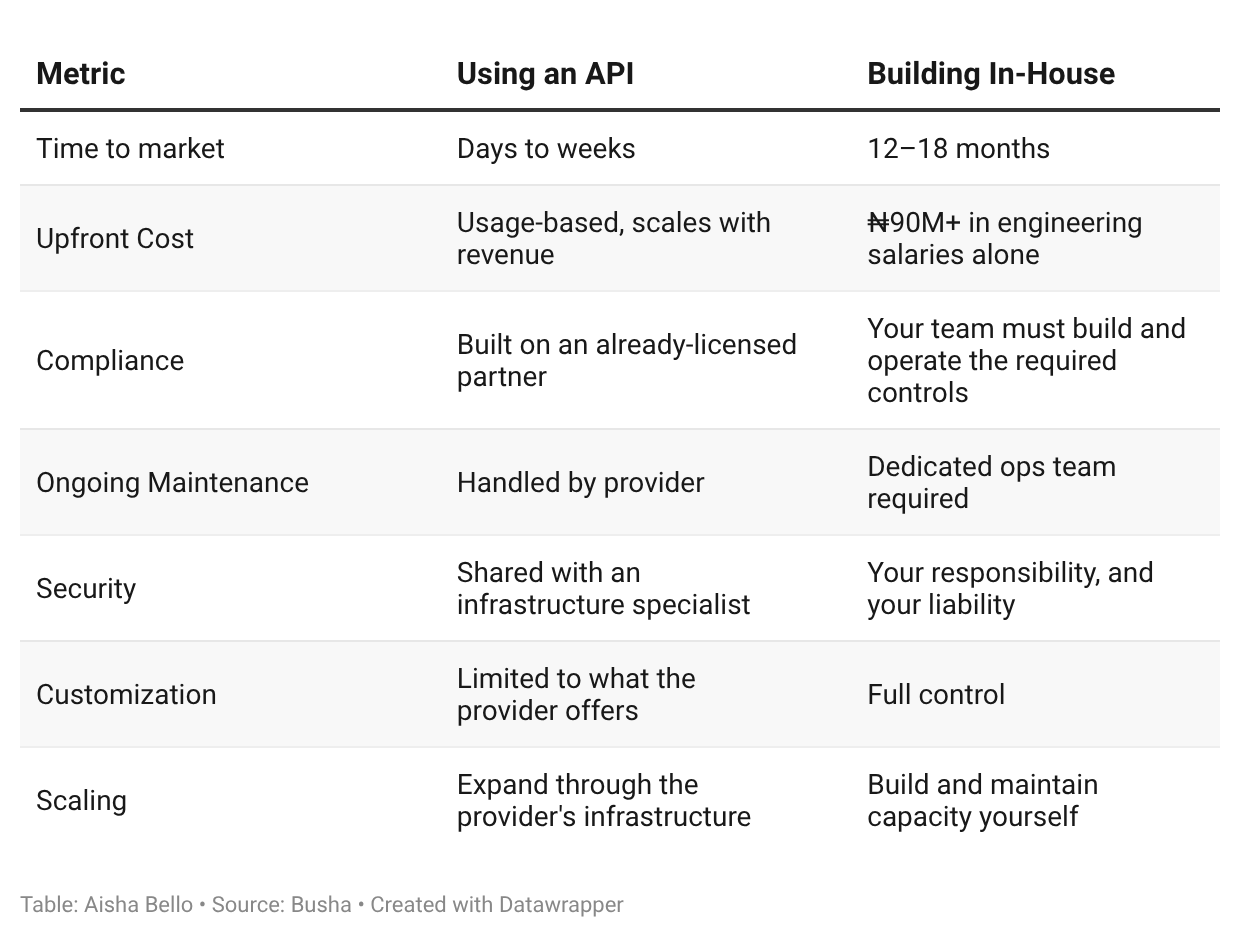
Take a hypothetical team of five engineers, each with a fully loaded annual cost of ₦36 million. Six months of development represents approximately ₦90 million in engineering cost before accounting for infrastructure, security, compliance, external integrations, operations, or ongoing maintenance.
Those six months also represent six months in which the same team could have been improving conversion, launching a new revenue feature, entering another market, or getting the crypto product in front of customers. The longer infrastructure takes to build, the more the business gives up elsewhere.
Financial institutions are already seeing the value of integrating capabilities rather than building every layer themselves. McKinsey found that 44% of banking executives surveyed expected their API programs to reduce costs by more than 10%, while 31% expected them to increase revenue by more than 10%. Payments were also the most common API use case among the banks surveyed.
Far beyond developer convenience, APIs allow financial businesses to add new capabilities without committing to the full cost of owning the underlying infrastructure.
What an API Changes
An API lets your existing application use a capability another company has already built.
For a fintech company adding crypto payments, this can significantly reduce the infrastructure the business needs to build internally. Rather than creating an entire payment system and then integrating every component required to make it operational, the engineering team can connect its existing product to specific financial capabilities through APIs.
However, using an API doesn't mean giving up control of the product.
Your team can still determine how the feature appears in the app, how customers interact with it, what business rules apply, and how the resulting transaction fits into the broader customer journey.
The infrastructure provider handles the capabilities exposed through its platform.
Building vs. Integrating
Where Busha Business fits
This is the problem Busha Business is designed to solve.
Busha Business provides APIs and developer tools that allow fintechs, neobanks, and other financial services to add digital-asset capabilities to their existing products without building every underlying component themselves.
Businesses can use the platform to:
- Accept payments through API: create payment requests, retrieve payment status, and automate updates with webhooks.
- Build on-ramp and off-ramp flows: support fiat-to-crypto and crypto-to-fiat transactions through quote and transfer APIs.
- Onboard customers: create and verify customers for B2B2C experiences.
- Deploy payment experiences: use SDKs, hosted checkout, and payment widgets where a faster implementation is appropriate.
With Busha Business, your business can complete account setup, undergo KYB verification, generate API credentials, and start integrating crypto capabilities without building the underlying infrastructure from scratch.
Build what differentiates your business. Integrate the infrastructure that makes it possible.